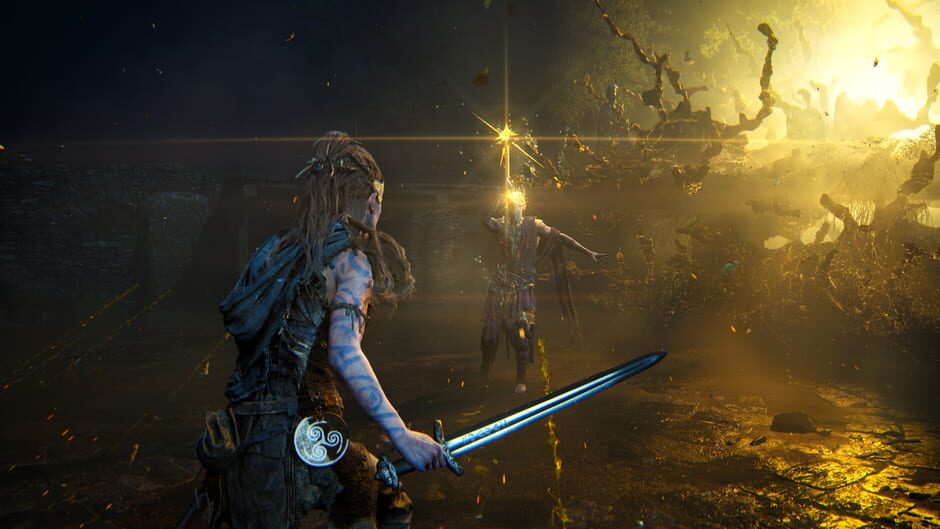
Senua
2027·Ninja Theory
About this game
Hellblade: Senua's Sacrifice was one of the most affecting games I've played. A team of 25 people built something that felt genuinely intimate with the experience of psychosis in a way no game had attempted before - the binaural audio, the voices, the constant psychological pressure of the world reading your fear back at you. Hellblade II expanded on that visually into something almost unbearably cinematic, though a lot of players found it leaned too heavily on presentation at the expense of actual gameplay. Both were remarkable. Both were also deliberately narrow in scope. Senua - announced at the Xbox Games Showcase on June 8, 2026, and coming in 2027 to Xbox Series X/S, PC via Steam, and PS5 with day-one Game Pass inclusion - is Ninja Theory's explicit answer to that feedback. And the approach they've taken is interesting: rather than calling it Hellblade 3 and iterating on the previous format, they've dropped the Hellblade name entirely, positioned this as a third chapter in the series rather than a sequel, and rebuilt from the ground up as a full action-adventure game with a meaningfully different design ambition. Studio head Dom Matthews was clear in his Xbox Wire interview: "This is an out-and-out action-adventure game. I think Hellblade 1 and Hellblade 2 had an intention that we delivered on - but this is a different intention." The word he used for it was "additive" - keeping everything that worked about the Hellblade games and layering on the systems and player agency the series couldn't accommodate at smaller scale. The whole 85-person Ninja Theory team is on this for the first time in over 12 years. That consolidation came at a cost - Project Mara, the experimental psychological horror title announced in 2020 that many people were curious about, has been formally cancelled to make it possible. Matthews made the decision himself. "I took the decision to not work on that any further," he said directly. That's a real sacrifice for something the studio clearly believed in, and it signals genuine commitment to what Senua can be at full studio scale. The setting follows directly from the events of both previous games. Senua is trapped between life and death in a fractured vision of Purgatory - specifically a warped version of her childhood homeland - and must fight to reach the afterlife to reunite with those she loved and lost. The psychological storytelling framework that defined the series is intact, but the world is substantially larger. The map is roughly twice the size of Hellblade II, built as a single interconnected space with returning areas, vertical exploration, optional secrets, and routes shaped by Senua's perception of the environment rather than a traditional open-world structure. Accessible to newcomers without requiring prior knowledge, while carrying meaningful thematic continuity for series veterans. Gameplay is designed around an equal three-way split between combat, traversal, and puzzle-solving - Matthews was explicit that this isn't a combat-heavy action game. Combat encounters now involve multiple enemies simultaneously, vertical spaces, environmental elements, expanded weapon options including dual-wielding, and stealth. The puzzle-solving inherits the series' existing tradition of perception-based environmental challenges. Everything is blended into a single continuous experience rather than presented as separate pillars. The binaural audio and psychological depth that made the originals distinct are still central. Melina Juergens, who won Best Performance at The Game Awards 2024 for Hellblade II, is confirmed to return as Senua. Ninja Theory described the narrative as exploring Senua's belief that healing the wounds of her past will open the gate to the afterlife - which is the most interior and personal framing the series has attempted yet. I played both Hellblade games with headphones in the dark, which is the only correct way to experience them. The idea of that same psychological texture and intimacy applied to a full-scale action-adventure with real exploration and a world twice the size of anything they've built before is genuinely exciting. The fact that the entire studio is behind it for the first time in over a decade suggests Ninja Theory believes this is the version of Senua's story they've always wanted to tell but haven't had the resources to build.